

Shopping for a diamond cross pendant looks simple until you actually start comparing listings. One site shows a $300 pendant, another mentions $1,200, and both call themselves "diamond cross necklaces." The difference rarely comes down to marketing. It comes down to carat weight, metal purity, construction quality, and what's actually holding those stones in place. This guide walks through what affects the price, how to judge quality without a gemology degree, which metal tone suits you best, and how to wear the piece once it's around your neck.
How Much Does a Diamond Cross Pendant Necklace Cost?
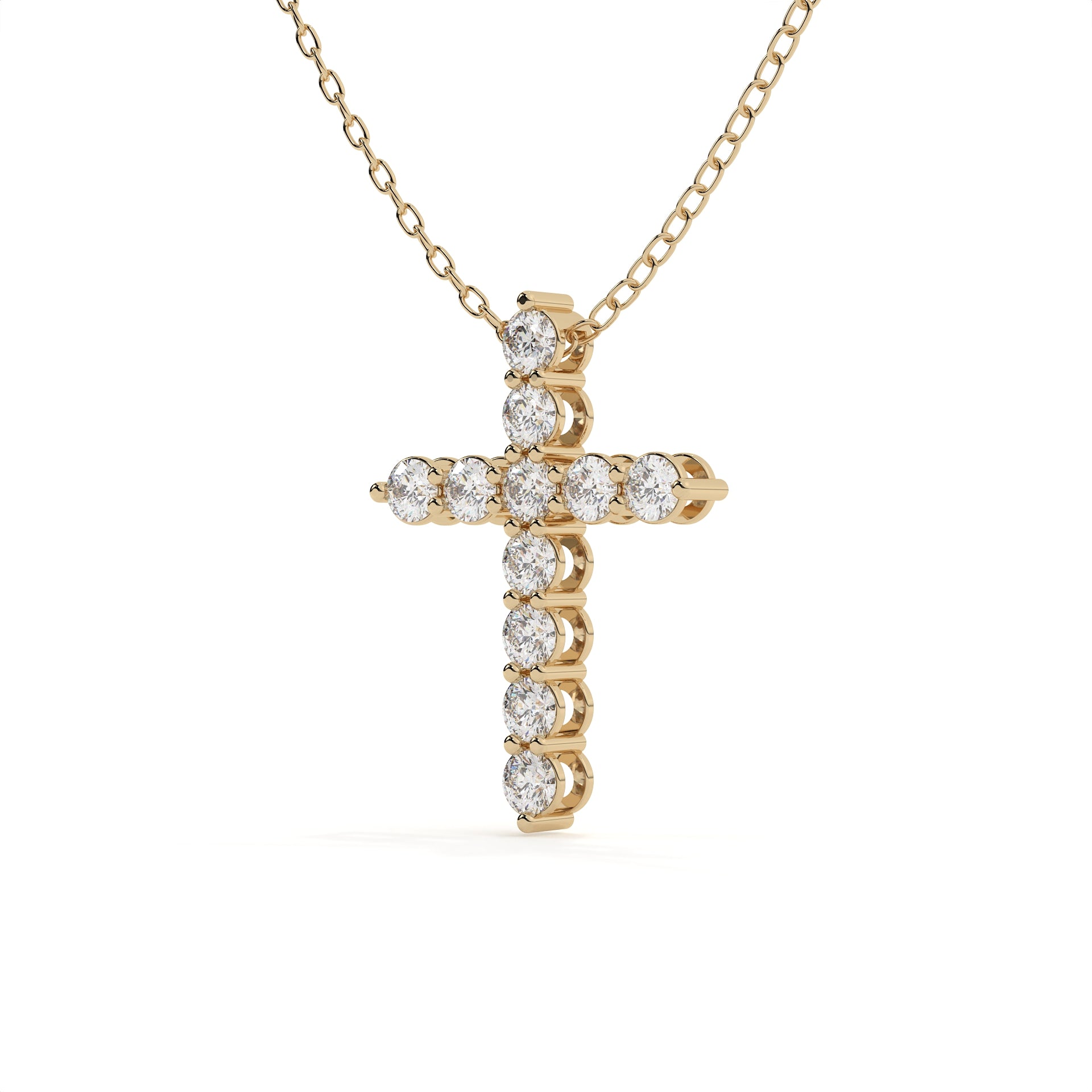
Diamond cross pendant prices vary according to total diamond weight, diamond origin, metal purity, setting complexity, certification, and whether a matching chain is included. There isn't one honest number that applies to every design. A 0.10-carat cross in sterling silver and a 1-carat cross in 18K gold both fall under the same search term, yet they aren't remotely comparable purchases.
A few of the biggest price drivers:
-
Total carat weight (CTW)
A pendant built from several small stones is priced on the combined weight of every diamond, not just the largest one. So, focus on how much the carat weight of the center stone contributes along with the accent diamonds.
-
Diamond origin
Lab-grown diamonds typically cost less than mined diamonds of the same size and grade, which is one reason lab-grown cross pendants have become a popular way to get more visible carat weight for the money.
-
Metal purity and weight
Sterling silver, 10K, 14K, and 18K gold all carry different material costs, and heavier settings use more metal. In gold, you have three metal tone options: white gold, rose gold, and yellow gold. Platinum is also a durable choice for a more premium metal tone.
-
Setting complexity
A pavé-covered cross with dozens of tiny stones takes more labor to set than a simple four-prong design. Also, a customized pendant necklaces prices starts from $1,000 minimum.
-
Certification
Independently graded diamonds through a lab like IGI add a layer of verified quality that unbranded stones don't have. Certified diamond jewelry is usually preferred for getting the original stones on the pendants.
-
Chain inclusion
Some listings price the pendant alone; others bundle a matching chain, which changes the comparison entirely. Check whether the pendant necklace comes with the chain or if you have to purchase the chain independently in 14K or 18K gold.
Instead of asking "what does a diamond cross necklace cost," a smarter question is "what am I comparing for that price?" Carat weight, metal, and certification should all match up before you compare two numbers side by side.
What Makes a Diamond Cross Necklace Worth Its Price?
Price and value aren't the same thing. A cross pendant earns its price through a combination of visible diamond performance, metal integrity, and how well it's built to survive daily wear.
Look past the sale tag and check:
-
Diamond quality relative to size
In diamond 4Cs, color and clarity affect how bright and clean the stones look. But for a pendant worn at conversation distance, near-colorless and eye-clean grades usually do the job without paying for the top of the grading scale.
-
Metal purity
For everyday jewelry that offers durability and cost well then 14K gold is enough. Pick 18K gold for its richer color and higher gold content, with a higher price tag. Choose 925 silver as the most affordable metal for a softer look and more careful wear. Platinum can be chosen if you’re willing to pay extra and want a premium-quality metal.
-
The setting
For a pendant necklace, the setting choices are countless. Prongs or pavé work should hold each stone securely, sit flush against the metal, and show no visible gaps. For a more unique pendant design, you can choose a diamond shape including round, emerald, cushion, oval, etc.
-
Chain and bail quality
The small loop connecting the pendant to the chain bail, which takes constant movement, should be soldered cleanly, not just a bent piece of wire. Check the gold metal content in the chain, like 14K, 18K, 925 Silver, or 950 Platinum.
-
Certification
A hallmark stamp and, where offered, an IGI report on the diamonds give you a paper trail if you ever need to insure, resize, or resell the piece. A certified diamond pendant necklace is assured jewelry you can gift any loved one for transparent purchase proof that can help them in the future.
Diamond Cross Pendant vs. Christ Pendant: What's the Difference?

Both are cross-shaped, both are worn the same way, and both carry religious meaning, but the visual design differs. A traditional diamond cross pendant, like Alyce Jewels' 1.11 Carat Round Cut Diamond Cross Pendant, uses a clean, symmetrical cross silhouette set with round diamonds, which reads as a classic, versatile shape that works equally well for daily wear or as a gift.
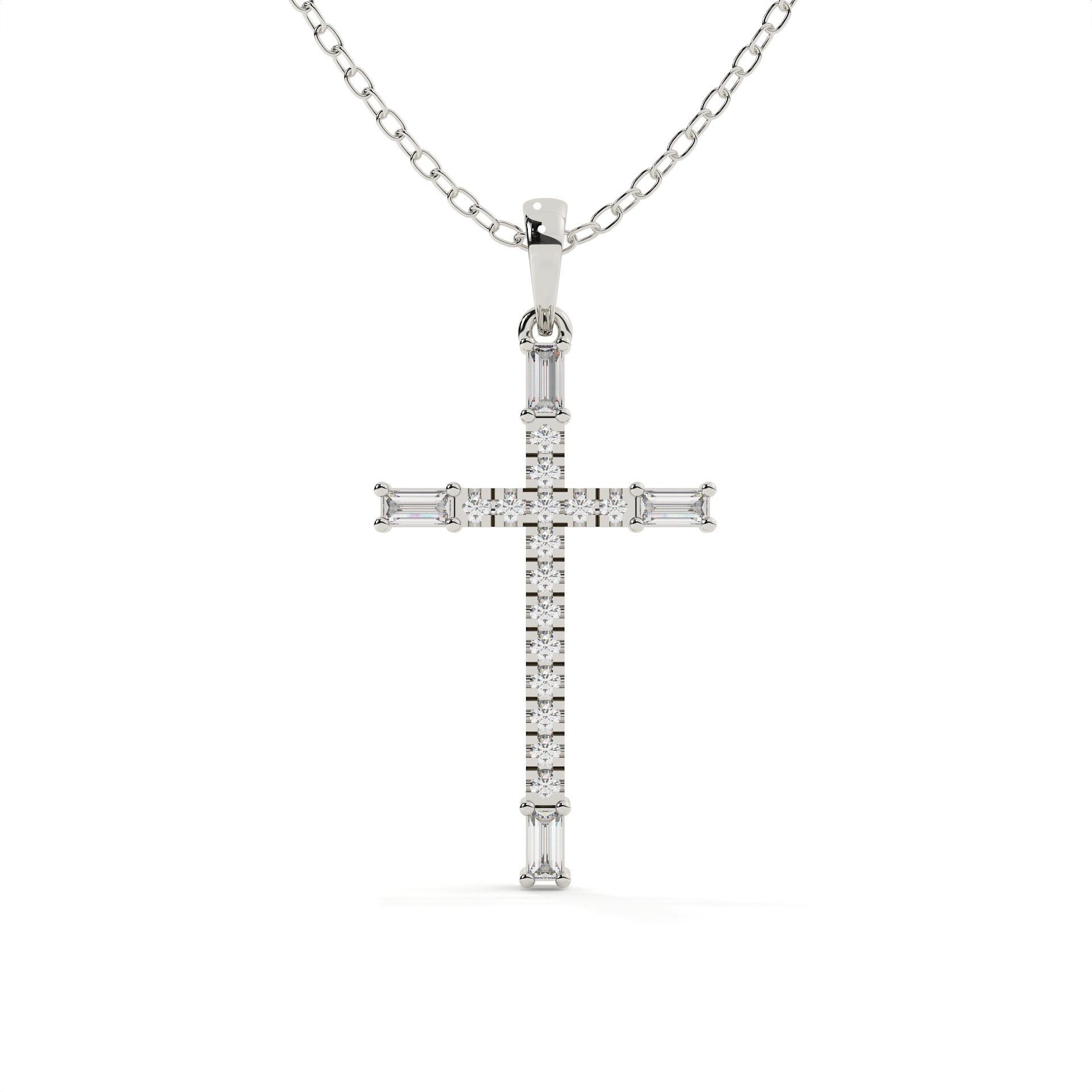
A Christ pendant, such as Alyce Jewels' 0.29 Carat Round and Baguette Cut Diamond Christ Pendant, builds on that cross shape with additional design detail. In this case, a mix of baguette and round-cut lab-grown diamonds (0.29 carats of baguettes and 0.23 carats of round stones, for roughly 0.52 total carats across the piece) is arranged for extra visual texture and light play from multiple angles.
Neither is "more religious" than the other; the distinction is aesthetic. Someone who wants an instantly recognizable, minimal cross silhouette likes to gravitate toward the round cut design. Someone drawn to a more detailed, faceted look often prefers the mixed-cut Christ pendant.
How to Choose the Right Diamond Quality?
The 4Cs, including cut, color, clarity, and carat, apply to pendant diamonds the same way they apply to any diamond, but the priorities shift slightly for a piece worn on a chain rather than examined under magnification.
-
Cut determines how much a diamond sparkles, and it matters most for round and other brilliant-style stones.
-
Color is graded on a scale where near-colorless grades (roughly D-H) look white to the eye. You rarely need to chase a fully colorless stone for a pendant.
-
Clarity measures internal characteristics. Eye-clean grades (no visible inclusions at normal viewing distance) matter more than a flawless grade nobody will ever notice.
-
Carat measures weight, not necessarily size or sparkle on its own.
For pendants built from multiple stones, total carat weight (CTW) is the number that actually describes the piece — it's the sum of every diamond's weight combined. A "1.00 CTW" pendant made of many small round stones will look different, and often larger across the design, than a single 1.00-carat center stone would. When comparing listings, check whether the carat figure refers to one stone or the whole piece, since the two numbers aren't interchangeable.
Yellow Gold vs. White Gold vs. Rose Gold for a Cross Pendant
|
Metal Tone |
Visual Character |
Works Well With |
Maintenance Note |
|
Yellow Gold |
Warm, traditional, classic cross look |
Warm-toned jewelry, vintage-inspired wardrobes |
Solid gold resists tarnish; occasional polishing keeps shine |
|
White Gold |
Cool, modern, blends with diamonds for a bright finish |
Silver-tone jewelry, minimalist and modern styles |
Rhodium plating (if used) may need reapplying over years |
|
Rose Gold |
Soft pink warmth, contemporary but not trend-only |
Mixed-metal stacks, romantic or vintage-modern styles |
Copper alloy is durable; color is part of the metal itself |
Skin tone is often oversimplified in jewelry advice. "Warm skin wears gold, cool skin wears silver" isn't a rule most stylists actually follow anymore. What matters more in practice is the jewelry you already own, the tones in your everyday wardrobe, and which look you're personally drawn to when you see it on.
-
Choose yellow gold if you want a traditional cross look, wear mostly gold jewelry already, or prefer a warmer overall palette.
-
Choose white gold if you want the diamonds to stand out with maximum brightness, wear mostly silver-tone pieces, or prefer a cooler, modern finish.
-
Choose rose gold if you want something a little different from classic yellow or white, enjoy a softer color story, or already mix rose-gold pieces into your jewelry rotation.
Alyce Jewels offers both the round-cut cross pendant and the Christ pendant in yellow, white, and rose gold, across 925 silver and 10K, 14K, and 18K solid gold, so the metal decision doesn't have to limit the design decision.
How to Wear a Diamond Cross Pendant Necklace
-
Chain length changes where the pendant sits.
This changes how chain length interacts with necklines. A shorter length sits higher and shows clearly against crew necks and higher collars. A longer length drops lower and pairs naturally with V-necks, open collars, and scoop-neck dresses. Since exact chain lengths vary by listing, check the specific product page for the measurement rather than assuming.
-
For everyday styling
A diamond cross pendant reads as refined compared to formal when it's the visual focus of simple outfits. Think a plain crew neck or fitted sweater competing with busy patterns or already-statement pieces.
-
When layering the necklace
Keep the diamond cross as the visually dominant piece by pairing it with a plain chain of a different length, so the two don't tangle or visually blend together. Varying the lengths noticeably, a few inches of separation keeps each piece distinct and prevents the shorter chain from sliding over the longer one during normal movement.
-
For mixing jewelry
Diamond studs and a cross pendant share a "diamond family" that reads as intentional. It’s not look like a mismatch. Gold bracelets, 2-carat diamond rings, and a watch all pair comfortably as long as no other piece competes directly with the pendant for attention.
-
On religious versus fashion styling appearance
A cross pendant carries genuine religious meaning for many wearers, while others choose it purely for the classic silhouette. Both are valid reasons to wear one, and neither requires justification to anyone else.
Can You Wear a Diamond Cross Necklace Every Day?
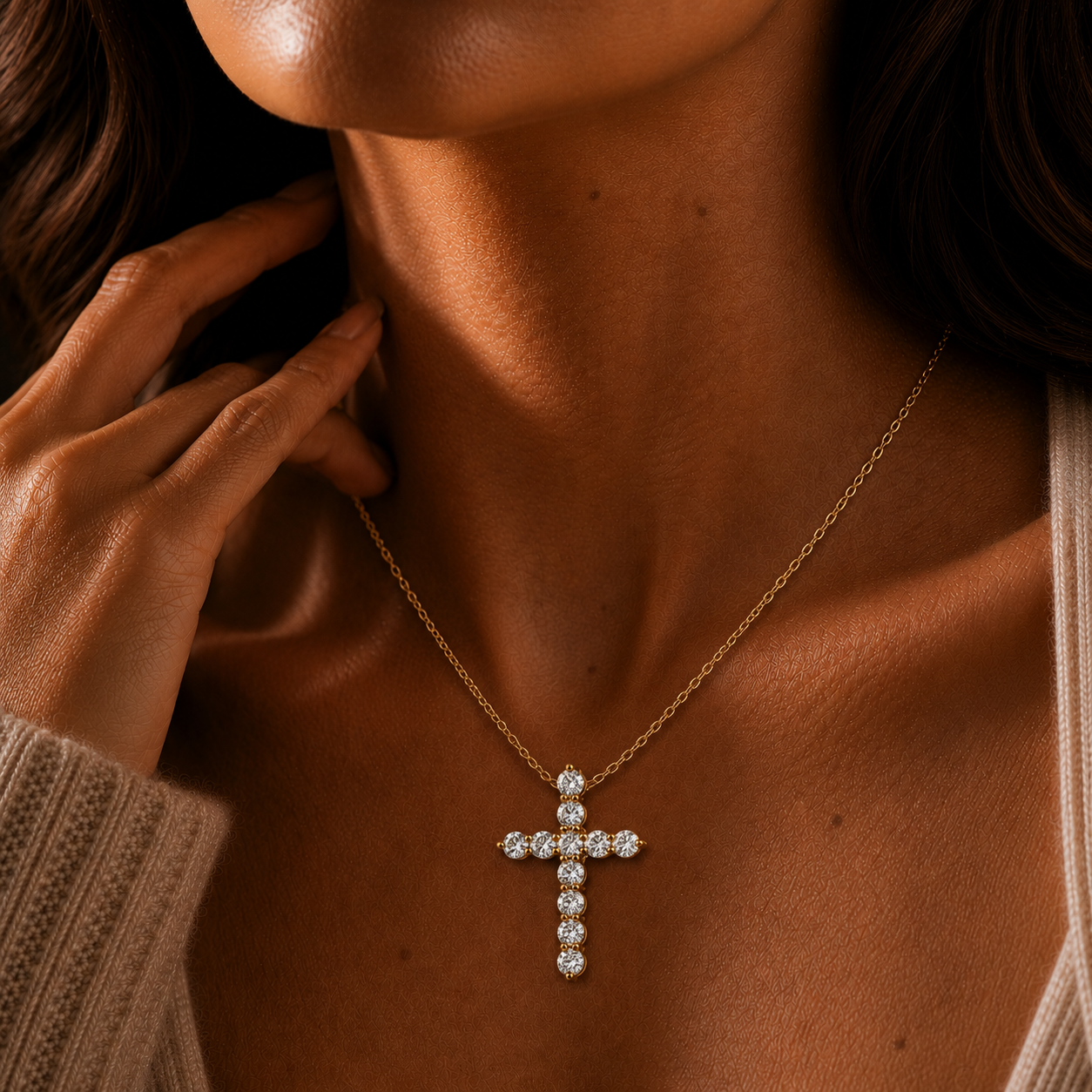
Diamonds themselves are extremely hard and resist scratching, but the metal setting, chain, and clasp holding them are what actually determine how the jewelry holds up to daily wear. A well-made setting in 14K or 18K gold can absolutely handle everyday use. But the vulnerable points are prongs that loosen over time, chains that catch on clothing, and clasps that wear down with repeated opening and closing.
Practical care that extends the life of any diamond pendant:
-
Remove it before swimming, since chlorine and saltwater can affect certain metals and platings over time.
-
Avoid unnecessary contact with harsh cleaning chemicals, lotions, and perfumes applied directly to the piece.
-
Take it off before activities where it could catch, snag, or take an impact — sports, heavy lifting, yard work.
-
Clean it gently with mild soap and warm water, using a soft brush for the settings.
-
Store it separately from other jewelry to prevent scratching.
-
Have the setting and chain periodically checked by a jeweler, since a loose prong is far easier to fix before a stone is lost than after.
Diamond jewelry isn't indestructible, but with reasonable care, a well-constructed cross pendant is a realistic everyday piece rather than an occasional-wear-only item.
What to Check Before Buying a Diamond Cross Pendant Online
Before adding a diamond cross pendant to your cart, verify:
-
Total carat weight and whether that figure applies to one stone or the full piece.
-
Metal purity and options, including silver, 10K, 14K, 18K, and which one you're actually selecting at checkout.
-
Diamond origin (lab-grown or mined) and whether that's clearly disclosed.
-
Certification availability, such as an IGI report. Even a GIA diamond report you can ask for.
-
Hallmark stamping, confirming the metal purity is marked on the piece itself.
-
Whether a chain is included or sold separately.
-
Return and exchange policy, in case the piece doesn't match expectations in person.
-
Current pricing, shipping timeline, and stock, since these details change and should always be confirmed on the live product page rather than assumed from a search result.
Which Alyce Jewels Diamond Cross Pendant Is Right for You?
Both pendants share the same foundation of lab-grown diamonds, a choice of 925 silver or solid 10K/14K/18K gold, and yellow, white, or rose metal tone options, but they suit slightly different buyers.
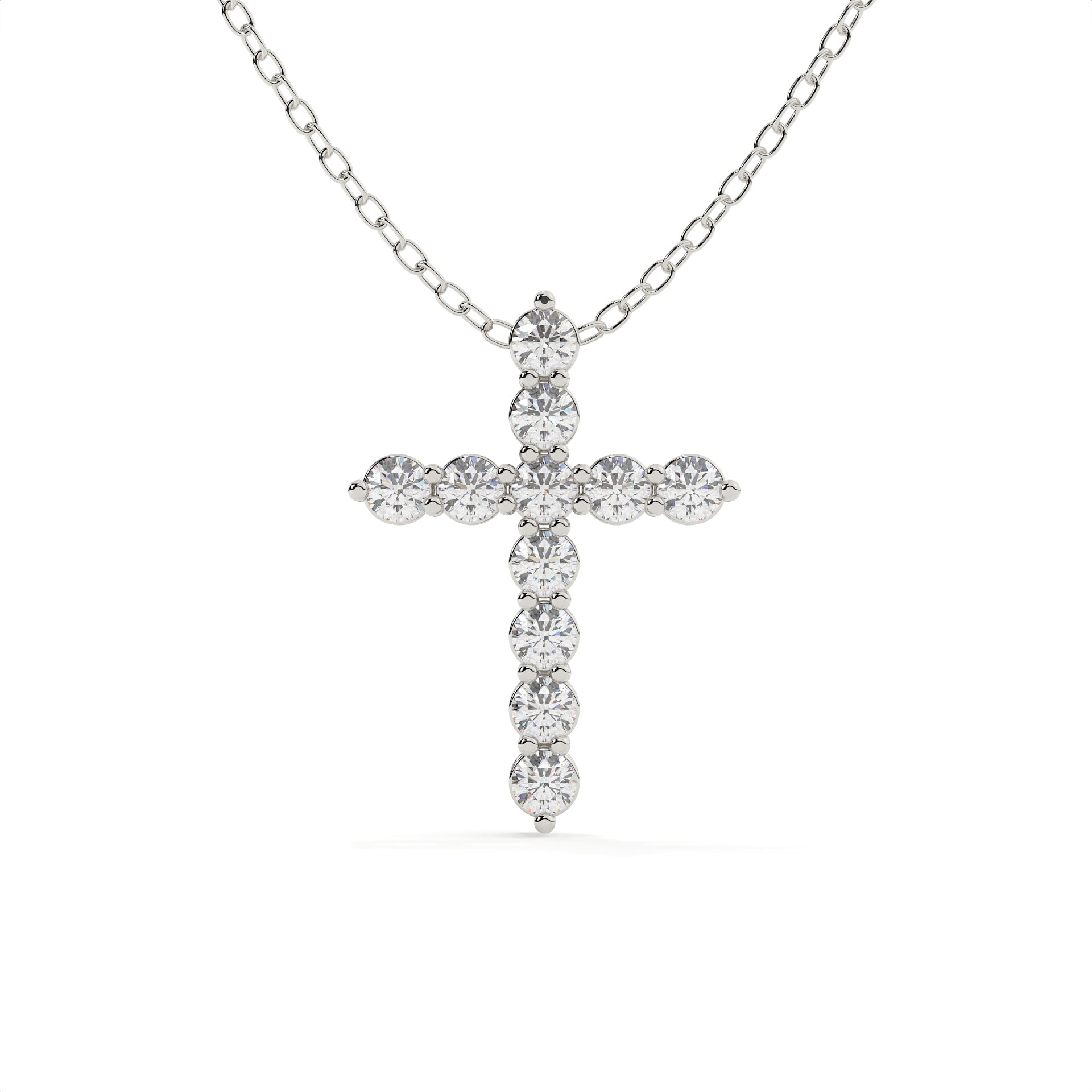
When you have a budget to buy a diamond cross pendant in $1,000 this pendant is the right choice. It’s made with round brilliant lab-grown diamonds placed under a prong setting to offer a classic and symmetrical cross shape. A buyer who wants a traditional, instantly recognizable cross silhouette with a higher total carat weight will find this gold pendant perfect. It can be worn daily, as a milestone gift, and as timeless jewelry.
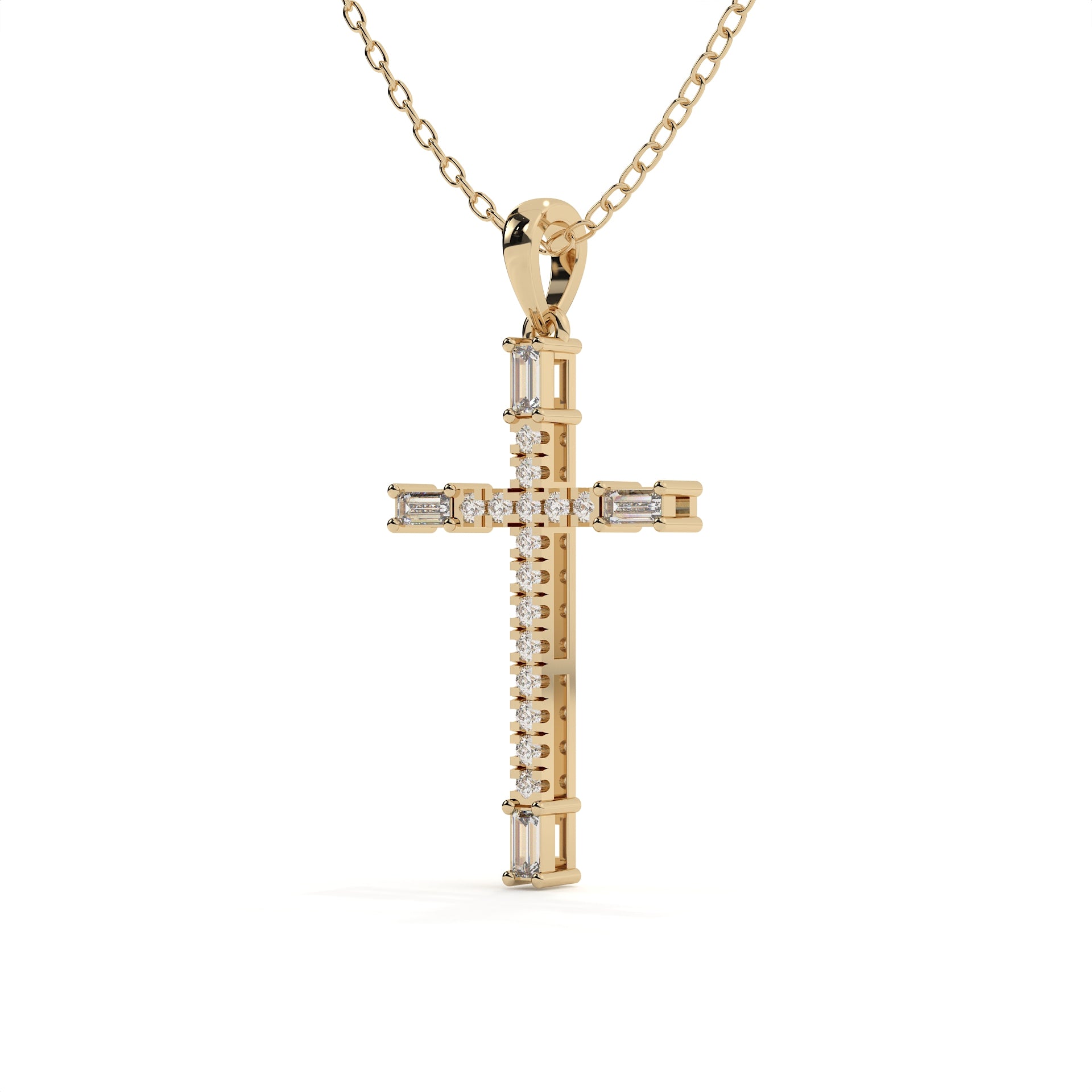
This pendant combines baguette and round stones for a more detailed, textured design. It suits a buyer drawn to a more intricate faith-inspired piece, someone who wants a design with more visual movement, or a gift for someone who already appreciates detailed jewelry design over minimal shapes. The look of a 14K gold pendant in diamonds is premium where it makes sense to suit the personality.
Neither is objectively "better." The round-cut cross leans classic and bold in carat weight, while the Christ pendant leans detailed and design-forward. The right choice comes down to which silhouette matches the wearer's existing style.
You can explore Alyce Jewels' lab-grown diamond pendant jewelry collection that comes with certified diamonds and excellent craftsmanship. You can also check the diamond tennis necklaces and Zodiac pendants to designed with diamonds and pure gold.
Making the Decision
A diamond cross pendant is one of those pieces that has to work on two levels at once: it needs to hold up as an everyday accessory, and it needs to mean something to the person wearing it. Getting there means comparing total carat weight and metal purity rather than price alone, choosing a metal tone that fits your existing wardrobe, and paying attention to setting and construction details that don't show up in a product photo.
If a classic, symmetrical silhouette with a strong total carat weight is what you're after, the 1.11-carat round-cut diamond cross pendant is built for that. If a more detailed, faceted design speaks to you instead, the round and baguette-cut Christ pendant offers that texture in a similarly wearable, IGI-certifiable piece. Either way, checking current pricing, metal options, and certification on the live product page is the last step worth taking before you buy.
FAQs
-
Is a lab-grown diamond cross necklace a real diamond?
Yes. Lab-grown diamonds share the same chemical composition and crystal structure as mined diamonds — the difference is where they're created, not what they're made of. They're distinct from cubic zirconia and moissanite, which are different materials entirely designed to resemble diamonds.
-
What does CTW mean on a diamond necklace?
CTW stands for total carat weight, the combined weight of every diamond in the piece, not the weight of a single stone. A pendant listed at 2.00 CTW built from multiple small diamonds will look different from a single 2-carat center stone.
-
Is a bigger diamond cross always better?
Not necessarily. A larger total carat weight can mean more visible sparkle, but metal quality, setting security, and how the design actually sits on the body matter just as much for everyday satisfaction with the piece.
-
Is a diamond cross pendant a good gift?
It's a common choice for birthdays, graduations, confirmations, and anniversaries specifically because the design carries meaning beyond its appearance, and the classic silhouette suits a wide range of personal styles.
-
How do I clean a diamond cross necklace?
Warm water, a mild dish soap, and a soft brush for the setting are usually enough. Avoid ultrasonic cleaners on pieces with delicate pavé settings, and store the pendant separately from other jewelry.
-
Should I choose yellow gold or white gold for a cross necklace?
Both work well. The decision usually comes down to which tone matches your existing jewelry and wardrobe more than any hard rule about skin tone.