

Place two diamonds of identical carat weight side by side, and they can look surprisingly different. One might sprawl across the finger with an elongated outline, while the other sits compact and tight. This is a matter of geometry. Carat weight measures how much a diamond weighs, not how much surface area it shows from above.
That distinction is the root of one of the most common questions in diamond shopping: which diamond shape looks biggest? The short answer is that elongated shapes like oval, pear, marquise, and some elongated radiant cuts tend to show more face-up surface for their weight, which often translates into a larger visual footprint.
But diamond shapes alone don't decide the outcome. Length, width, depth, length-to-width ratio, table size, and overall cut proportions all play a role, and two diamonds of the same shape can still look meaningfully different from one another.
Which Diamond Shape Is Best for You?
-
Choose oval if you want an elongated, elegant look with strong visual coverage.
-
Choose pear if you want a distinctive silhouette with an elongated outline.
-
Choose radiant if you want visual presence paired with brilliant faceting.
-
Choose round if you prioritize classic styling and traditional brilliance.
-
Choose emerald if you prefer clean geometry and broad step-cut facets.
-
Choose cushion if you want a softer, more romantic outline.
-
Choose princess if you prefer a square, modern appearance.
There's no universally "correct" answer — the right shape is the one that matches how you want the diamond to look and wear.
Which Diamond Shape Looks Biggest for the Same Carat Weight?
For a given carat weight, let’s say a 2-carat ring, elongated shapes generally offer the strongest face-up coverage. Here's how that tends to play out shape by shape:
-
Oval diamonds show a large visible surface because their length stretches across more of the finger than a rounder outline would at the same weight.
-
Pear diamonds can appear expansive thanks to their elongated silhouette, with the tapered point adding to the sense of length.
-
Marquise diamonds, with their pointed ends and long body, frequently produce some of the largest visual spread of any shape.
-
Elongated radiant cuts combine a stretched rectangular outline with brilliant faceting, offering strong coverage without sacrificing sparkle.
-
Emerald cuts have a broad, open table and a wide visual footprint, but their step-cut faceting reads differently than a brilliant cut. It is the size impression comes from clean geometry rather than fire.
-
Round diamonds are cut for brilliance and light performance, which means more of their weight is held in depth rather than spread across the surface. That's part of why a round diamond can look smaller than an elongated shape at the same carat weight.
-
Cushion and princess cuts fall in between, with visual size depending heavily on the individual stone's proportions.
This is a general tendency, not a guarantee. A poorly proportioned oval can look smaller than a well-cut round of the same weight. The individual diamond's measurements matter more than the shape name printed on the certificate.
Why Carat Weight Doesn't Tell You How Big a Diamond Looks
Carat weight is a measurement of mass: one carat equals 0.2 grams, regardless of shape. It says nothing about the diamond's outline, length, or width. Four related concepts explain why weight and visible size diverge:
-
Face-up size refers to the diamond's visible dimensions when viewed from directly above. It is essentially what someone sees when they look down at the ring.
-
Depth describes how much of the diamond's material extends downward, hidden beneath the setting once it's mounted.
-
Spread is the relationship between a diamond's apparent surface area and its carat weight; a diamond with good spread shows more face for the same weight.
-
Length-to-width ratio determines how elongated or compact the outline appears, which directly affects how much finger space the stone covers.
Put simply, a 1-carat elongated diamond may cover noticeably more visible finger space than a 1-carat diamond that carries more of its weight in depth, even though the scale reads the same number for both.
Oval Shape Diamonds - One of the Best Choices for Visual Size

Oval diamonds have become a popular choice for buyers who want a center stone that reads large. Their elongated silhouette naturally stretches across the finger, and the brilliant faceting pattern delivers strong sparkle alongside that coverage. Many buyers also find that the 1 to 3-carat weight oval diamond shape has a subtly finger-lengthening effect, and it pairs well with both simple solitaire settings and more elaborate halo designs.
That said, ovals vary considerably. Length-to-width ratio can range from nearly round to distinctly slender, and depth percentage affects how much of the carat weight actually shows up front. Also, the bow-tie effect make oval shaped diamond useful for the ring's appearance.
Not every oval outperforms every round diamond. But as a category, oval-cut lab-grown diamond engagement rings are a strong starting point for buyers prioritizing visual presence.
Pear Diamonds Cut - High Visual Impact With an Elongated Shape

The pear shape combines a rounded lower body with a pointed tip, creating a teardrop outline that reads as distinctly larger than its carat weight might suggest. The broad base contributes to face-up coverage, while the tapered point adds length. Diamond symmetry matters more here than in most diamond shapes; an off-center point or an uneven curve is more noticeable in an elongated outline, and the pointed tip benefits from a protective prong in the setting.
Orientation also affects how the stone is perceived: 0.50 carat to 3-carat weight pear diamonds are typically worn with the point facing toward the fingertip, which reinforces the finger-lengthening visual effect. Prefer the VVS or VS clarity when selecting a three-stone-like design for an engagement ring.
Buyers drawn to this look can explore pear-cut lab-grown diamond engagement rings for a shape that pairs strong coverage with a distinctive silhouette.
Radiant Cut - Large-Looking With Brilliant Faceting
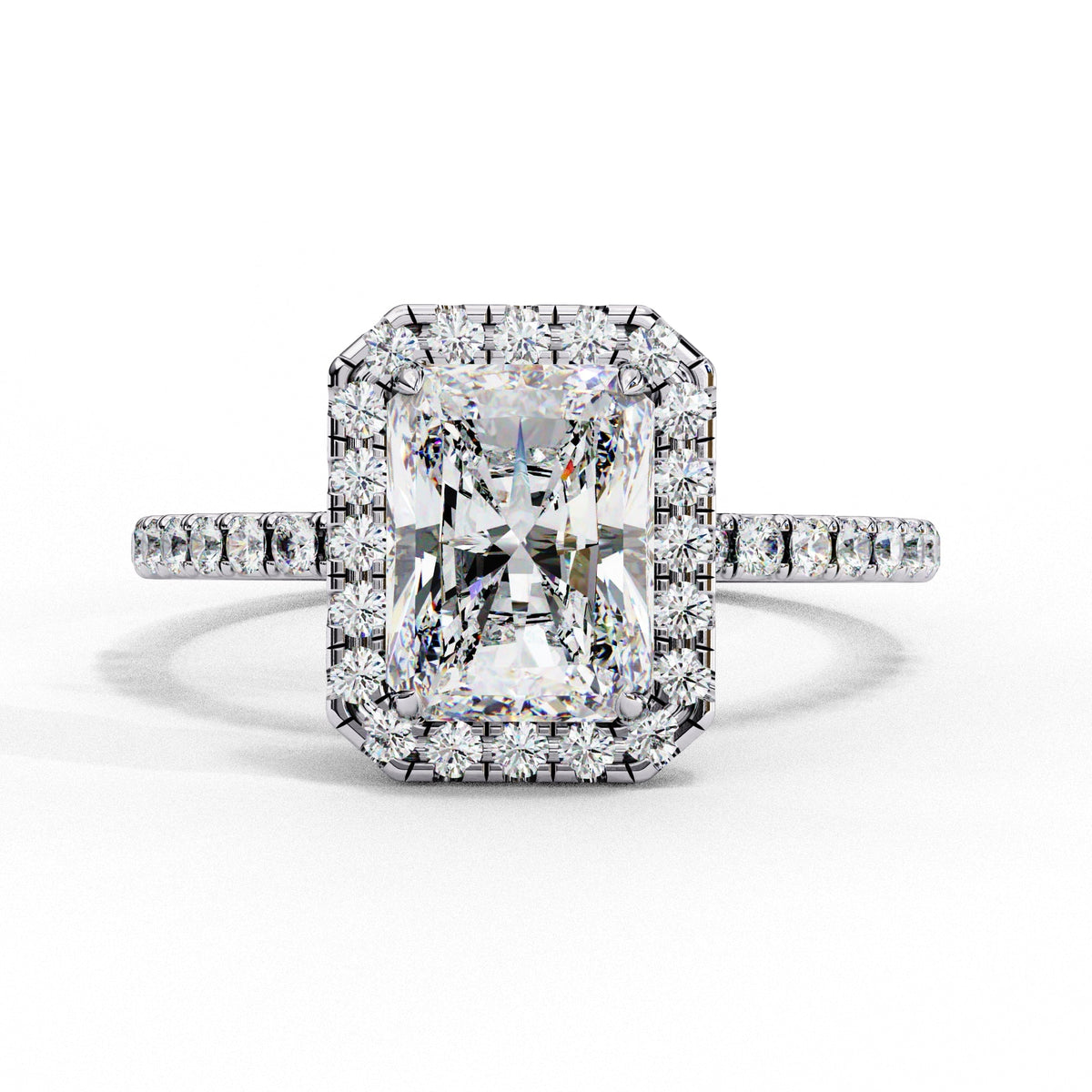
Radiant cuts feature a rectangular or square outline with trimmed corners, combined with a brilliant-style faceting pattern that produces strong sparkle.
The rectangular shape naturally offers a broad face-up profile, and elongated radiant proportions in particular can deliver both visual spread and fire, a combination that appeals to buyers who don't want to choose between size and sparkle.
For this look, radiant-cut lab-grown diamond engagement rings are worth comparing directly against oval and pear options. You can select a halo design or a vintage-inspired setting in 14KT yellow gold or 18KT white gold for a more unique look on the finger.
Round vs. Oval vs. Pear Cut Diamond: Which Looks Bigger?
|
Shape |
General Visual Coverage |
Appearance |
Important Consideration |
|
Oval |
High |
Elongated and elegant |
Proportions vary considerably |
|
Pear |
High |
Elongated and distinctive |
Symmetry and tip protection matter |
|
Round |
Moderate relative to some elongated shapes |
Classic and brilliant |
Depth and diameter influence spread |
|
Radiant |
Moderate to high |
Modern and brilliant |
Elongated proportions can increase coverage |
This table reflects general visual tendencies, not fixed measurements. Two diamonds within the same shape category can still differ in how large they appear once actual proportions are compared.
Do Emerald, Cushion and Princess Diamonds Look Big?

-
Emerald cut diamonds
Emerald cuts have a broad, open table and clean rectangular geometry, producing what's sometimes called a "hall of mirrors" effect as light moves across the step-cut facets. They can look quite substantial even in 1-carat weights, though their visual appeal leans more on clarity and outline than on the intense sparkle of a brilliant cut. Explore emerald-cut lab-grown diamond engagement rings to compare this understated look.
-
Cushion-cut diamonds
Cushion-shaped diamonds have softened, rounded corners and a romantic, pillow-like outline. Their visual presence varies more than most shapes like round or emerald because cushion proportions and facet patterns differ widely between stones. Browse cushion-cut lab-grown diamond engagement rings to see this range firsthand.
-
Princess-cut diamonds
Princess-cut diamonds offer a square outline with brilliant faceting and a modern, geometric feel. This diamond face-up size depends heavily on depth and proportions, so it's worth comparing individual stones rather than assuming a fixed size for the shape. See available princess-cut diamond engagement rings for reference.
Which Diamond Shape Gives the Most Finger Coverage?
Elongated shapes, oval, pear, marquise, and elongated radiant cuts, generally provide the most finger coverage because their length extends further across the hand. But finger coverage should be evaluated using the diamond's actual length and width measurements, not carat weight alone. Two shapes can occupy the same visual footprint despite carrying different carat weights, and two diamonds of the same shape can cover noticeably different amounts of finger space depending on their individual dimensions.
How to Choose a Diamond Cut Shape That Looks Bigger Without Paying for More Carat Weight
1. Compare measurements, not just carat weight. Ask for length and width dimensions alongside the carat figure.
2. Consider an elongated shape. Oval, pear, marquise, and elongated radiant cuts look to offer stronger face-up coverage per carat.
3. Review proportions. Depth percentage and table size affect how a diamond's weight is distributed and how much shows from above.
4. Choose the setting carefully. A halo setting can visually expand the center stone's footprint, and a hidden halo adds sparkle at the base without widening the profile. Slim bands can also make the center stone appear more prominent by comparison. None of these choices change the diamond's actual carat weight.
5. Compare stones individually. Even within the same shape and carat weight, two diamonds can look different once you see their proportions side by side.
6. Don't sacrifice cut quality solely for size. A diamond that's cut too shallow or too deep to appear larger often loses brilliance in the process — visual spread shouldn't come at the expense of an unattractive stone.
Does a Lab-Grown Diamond Look Bigger for the Same Carat?
The connection between carat weight, dimensions, and shape is the same for lab-grown and natural diamonds because origin doesn't change the underlying geometry. A lab-grown oval and a natural oval of identical proportions and carat weight will show the same face-up size.
Where lab-grown diamonds do make a practical difference is budget flexibility. Because pricing structures for lab-grown stones can differ from natural diamonds, buyers sometimes find more room to allocate their budget toward a larger carat weight, a stronger cut grade, a preferred shape, or a more elaborate setting.
Shop Lab-Grown Diamond Engagement Rings by Shape at Alyce Jewels
Once you understand how shape, proportions, and setting interact, comparing real diamonds becomes much easier. Alyce Jewels offers lab-grown diamond engagement rings across all of the shapes discussed here, making it straightforward to compare an elongated oval against a classic round, or a broad emerald cut against a brilliant radiant, before deciding which visual profile suits you.
Conclusion
There's no single diamond shape that looks biggest in every comparison. Oval, pear, marquise, and elongated radiant cuts frequently provide strong visual coverage for their carat weight, but the individual stone's length, width, depth, cut quality, and setting ultimately decide what you actually see on the finger. Rather than relying on carat weight alone, compare real measurements and proportions side by side. When you're ready to see how these differences play out in person, explore Alyce Jewels' lab-grown diamond engagement rings by shape and compare your favorites directly.
FAQ
-
What diamond shape looks the largest?
Elongated shapes frequently offer strong face-up coverage, but the actual outcome depends on each diamond's specific proportions rather than the shape category alone.
-
Does a 1-carat oval look bigger than a 1-carat round?
It often does, because ovals look to spread more surface area across the same weight. This isn't guaranteed, though; a shallow, wide oval and a well-cut round can end up closer in visual size than expected.
-
Does carat weight determine how big a diamond looks?
Not directly. Carat weight measures mass, while visible size depends on face-up dimensions, depth, and proportions. Two diamonds of equal weight can have very different visual footprints.
-
How can I make my engagement ring look bigger?
Consider an elongated shape, compare actual length and width dimensions, review depth and table proportions, and choose a setting such as a halo or slim band that complements the center stone's visual presence.
-
Is a bigger-looking diamond always better?
Not necessarily. Cut quality, personal style, and proportions matter as much as visual size. A diamond that's cut poorly to maximize spread often loses brilliance and overall appeal.