
Vintage Lab-Grown Diamond Rings: Cathedral, Floral and Halo Details
In this guide
A ring made today is half a century short of vintage. The Knot's guide to antique engagement rings (March 2023) defines vintage as at least 50 years old and antique as at least 100, so a ring made in 2026 qualifies in 2076 and 2126, respectively. That is why vintage lab-grown diamond rings are really vintage-style rings: new pieces that borrow raised arches, petal layouts, and rows of small stones from older jewelry. This guide explains each of those details, what it does on the hand, which era it echoes, and how to tell from a product page whether a ring really has it. Alyce's five rings in this style come in near the end. To browse first, start with the lab-grown diamond engagement rings.
Key Takeaways
- The Knot defines vintage as at least 50 years old and antique as at least 100, so a ring made in 2026 reaches vintage status in 2076 (2026 + 50) and antique status in 2126.
- In The Knot's 2024 Jewelry and Engagement Study, 9% of couples chose a cathedral setting, 13% a classic halo and 13% a pavé band, while 35% chose a plain prong setting.
- Yellow gold held 36% of engagement rings in that 2024 study, and 39% in the 2026 edition, which National Jeweler reported in March 2026, so a warm metal is a mainstream choice.
- Jewelers Mutual, a jewelry insurer, calls a bezel the most secure setting, and its inspection guide recommends professional checks about twice a year.
- Alyce's five vintage-style rings use modern cuts: emerald, princess, marquise, and round.
Quick Answer
- What makes a lab-grown diamond ring look vintage? Design, not age: A raised cathedral setting, a floral or cluster stone layout, and halo or pavé accents borrowed from Victorian to Retro rings.
- Is a cathedral setting practical every day? It can be, but arches collect dirt and lift the stone higher, so clean underneath and have a jeweler inspect the prongs about twice a year.
- Which vintage-style ring should you look at first? Alyce lists emerald and princess cathedral rings, a criss-cross halo and a floral marquise band; compare center weight and metal before anything else.
Why a New Ring Can't Be Vintage, and Why That's Fine
The Knot's guide puts the cutoffs at 50 and 100 years and adds a wrinkle for the 1920s: early Art Deco rings from 1920 to 1923 count as antique, while later ones from 1924 to 1935 count only as vintage. Estate means pre-owned at any age, and Retro names a design period, not an age. A new ring is none of these, and the honest label for it is vintage-style or vintage-inspired.
The arithmetic is simple. At the 50-year cutoff, a ring bought in 2026 becomes vintage in 2076 (2026 + 50), and at the 100-year cutoff it becomes antique in 2126 (2026 + 100). Those are one publication's definitions, not legal categories. What a new ring can do is carry the design vocabulary of the periods it admires, which is where the rest of this guide spends its time. One more point belongs here: the stone is a real diamond. Under the Federal Trade Commission's Jewelry Guides, a diamond is defined by its chemistry and crystal structure, and a laboratory-created diamond may be called one with a clear disclosure.
Four Eras, Four Things Worth Borrowing
The Gemological Institute of America publishes an overview of historic jewelry design periods. Read the ring page next; it gives you a vocabulary.
- Victorian (1837 to 1901): It's a romantic and nature-themed era, mourning jewelry in the middle years, and lighter, more delicate work late in the reign. Flowers, cameos, and revived Gothic or Renaissance motifs were common.
- Edwardian (about 1900 to 1915): The Garland style, with flower garlands tied by ribbons and bows. Platinum began replacing silver, and finer diamonds took center stage.
- Art Deco (1920s to 1930s): A reaction to those soft garlands, with geometric patterns, streamlined forms, and bold contrast. Platinum stayed popular.
- Retro (1940s): Wartime shortages limited gems, and platinum went to the military, so gold and rose gold dominated. Designs turned bold and sculpted.
Matching Alyce rings to eras is our reading, not a claim the pages make. An emerald cut is a stepped shape, which suits the geometry of Art Deco, so the two emerald cathedral rings sit closest to that look. A marquise-petal band borrows the Victorian flower motif. No ring is a copy of a period piece.
Cathedral Settings: What the Arches Do
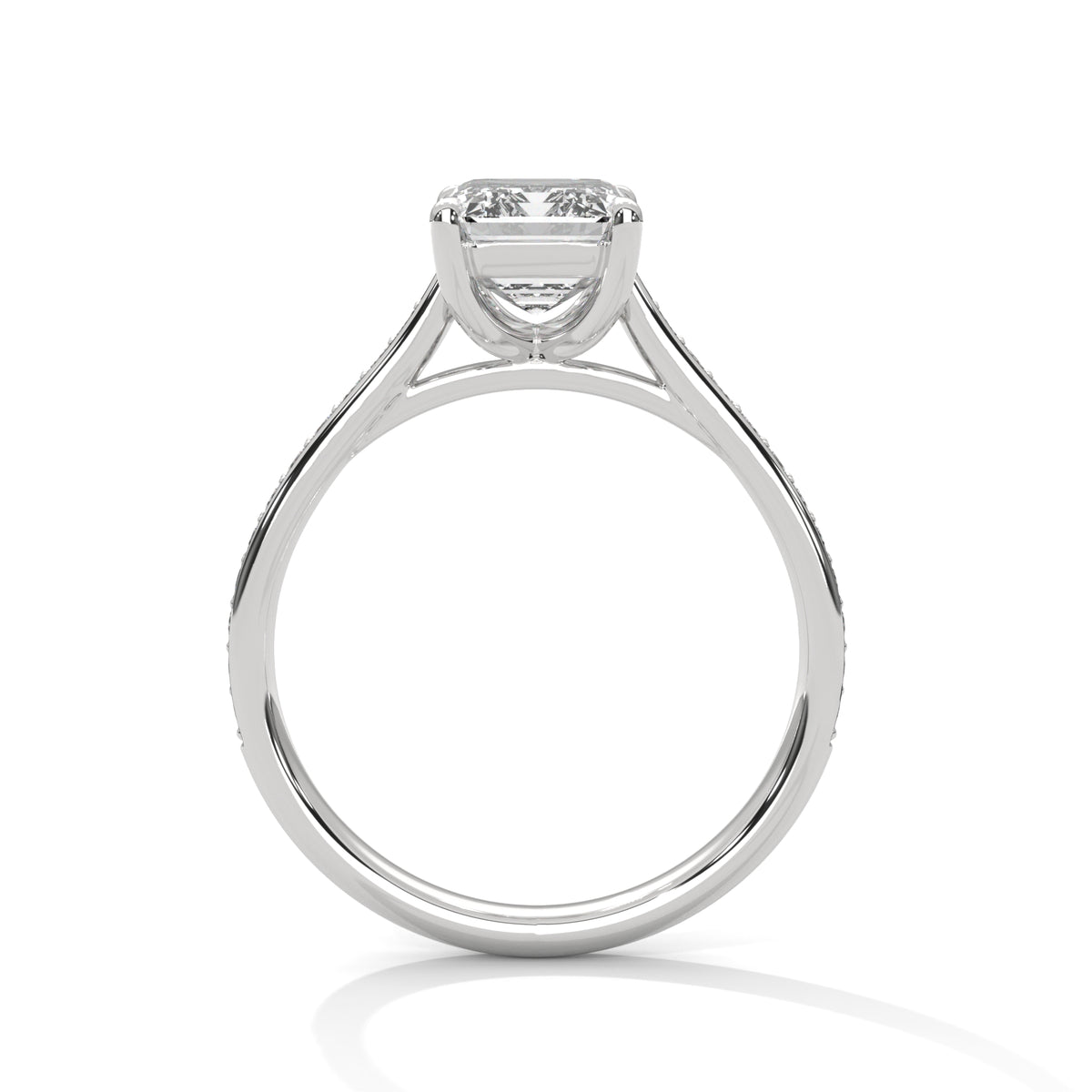
In a cathedral setting, two metal arches rise from the shoulders and meet the head that holds the stone, lifting it above the finger. Jewelers Mutual describes the style as two arches raising the center stone, which is held by prongs or a bezel. From the side, you see open space under the diamond. In The Knot's 2024 study, 9% of couples chose it.
The trade-offs are practical. Height exposes the stone: A ring sitting high may get bumped or scratched by people who work with their hands, and calls the bezel the most secure option. Dirt gathers under the head. And the prongs still do the holding, so they need a professional look; the insurer's inspection guide recommends cleaning and inspection about twice a year, and every three to four months for heavily worn pieces such as engagement rings. The arches themselves are a design choice that lifts the stone, not armor around it.
The bridge and your wedding band
The bridge is the horizontal metal piece joining the arches under the stone, and its height decides how a wedding band will sit. A Pricescope community thread from September 2023 shows the debate. One member recommended matching the bridge height to the band's depth for a flush look and better protection of the ring, and said a lower bridge works with a plain band or a bezel-set one. Another, who owned two cathedral rings, said neither bridge matched the band height and that forcing a match would make the head too high. Both agreed on one risk: a prong-set diamond band can grind against the ring's metal, and a spacer prevents it. If a band is in your plans, measure the bridge in millimeters and the band's depth, and compare them before you buy.
Alyce lists three cathedral rings. The 2.49 carat emerald cut halo cathedral ring lists emerald and round stones at 2.49 TCW, with no center weight. The 2 carat princess cut cathedral ring lists a 2.00 CT princess center plus 0.24 TCW of round accents. The emerald cut cathedral setting ring lists emerald and round stones at 2.40 TCW. Princess and emerald corners are the weak points of those shapes, so our princess cut ring guide and emerald cut ring guide cover how to protect them.
Petals and Clusters in
A floral ring comes in two forms. In a cluster, several small stones are grouped into a flower head. In a petal layout, shaped stones such as marquise cuts radiate around a center. The flower is one of the oldest motifs in the GIA's Victorian section, which is why the style reads as period work even in a modern cut.
Construction brings consequences. A marquise has two pointed ends, which are exposed corners, so a petal layout built from marquise stones needs the points covered by the setting. More small stones mean more places for dust to settle, so the soft-brush routine matters more than it does for a solitaire. And a band set with stones all the way around leaves less bare metal for a jeweler to work with, which matters if your size might change.
The 1.67 carat marquise floral eternity band is Alyce's floral piece. Its spec table lists marquise stones at 1.67 TCW plus round stones at 0.81 TCW, and its description says the marquise stones are arranged in a floral style. Our full versus half eternity band guide explains how coverage changes comfort and fit, and the marquise cut ring guide covers tip protection.
Halos and Pavé: The Quickest Route to Period Detail

A halo adds vintage-style detail to a modern stone, and a pavé band adds a second line of small stones along the shank. In The Knot's 2024 study, classic halos and pavé bands each drew 13% of couples, and hidden halos 18%. In our reading, a halo that follows the stone's outline looks modern, while scalloped or flower-shaped outlines and extra band detail look more period. The 1.40 carat criss-cross halo ring pairs a round halo with a criss-cross band at 1.40 TCW.
For halo width and accent stone size, our guide to halo engagement rings by diamond shape has the measurements, and hidden halo diamond shapes covers the version with small stones under the center. See the halo engagement ring collection for every style, which diamond shape looks biggest for the carat, and how much a halo adds to apparent size.
Old Cuts, New Stones

Real Victorian and Edwardian rings often carry old mine or old European cuts. National Jeweler's report on the debate over old cuts (May 2016) explains the difference: old mine cuts are early cushion-shaped stones made before the 1874 bruting machine, with small tables, steep crowns and large culets, and old European cuts are their round successors. Modern rounds differ mainly in the lower girdle facets, which cutters lengthened from the 1920s to add scintillation under electric light. The Knot's antique-ring guide lists old mine, old European, transitional, cushion, Asscher, and marquise as center-stone shapes that vary by era.
Some sellers advertise old-style cuts in lab-grown stones, but none of Alyce's five ring pages names one. If you want the feel without the cut, an emerald cut gives stepped planes, and National Jeweler's 2026 trends report describes the elongated cushion as the modern cousin of the old mine cut; see our cushion cut ring guide. For grading terms, use the 4Cs guide.
Reading a Listing Like a Skeptic
A listing can say vintage and still show none of the details that create the look. This table sets each common claim beside what it should look like in photos and what Alyce's five ring pages actually show.
| The listing says | A real example looks like | What Alyce's five ring pages show |
|---|---|---|
| Cathedral setting | Arches rising from both shoulders to the head, clear in a side photo | Three ring names say cathedral; none gives the stone's height |
| Halo | A ring of small stones around the center, seen from above | Named on the emerald cathedral halo ring and the criss-cross ring |
| Milgrain (beaded edge) | Tiny beads along the metal border in a close-up | May be available |
| Filigree (openwork) | See-through, lace-like metal in the band or gallery | May be customized |
| Hand engraving | Patterns cut into the metal, described in the text | Personalization available |
| Floral layout | Marquise or round stones set as petals | One band is described as set in a floral style |
| Old-style cut | A name such as old mine or old European in the spec table | Specs list emerald, princess, marquise, and round |
That is fine for a modern ring, but it means milgrain, filigree, and engraving should not be assumed from a product title. When a detail matters to you, look for it in a close-up photo or ask for one.
Pairing the Ring With a Band
A band that works depends on the gap under the ring, the stones on each side, and whether the pieces touch. A cathedral ring with a low bridge pairs best with a plain or bezel-set band, and a prong-set diamond band can rub the ring's metal, as the community thread above describes. Tall arches leave room for a straight band to sit against the ring. A halo or pavé ring usually wants a thin plain band, or a curved one, with clearance beside the halo checked first. A floral or cluster ring lets a thin plain band do its job without competing. Browse the bridal jewelry collection, and try a band against a side photo of the ring before the ring is made, because made-to-order rings may not be returnable once modified.
Where Alyce's Rings Fit

Every ring below is listed with EF color and VVS to VS clarity.
- Raised arches: the 2.49 TCW emerald halo cathedral ring adds a halo
- The 2 carat princess ring pairs a 2.00 CT center with an accent band
- The 2.40 TCW emerald cathedral ring has a light accent band.
- Floral layout: the 1.67 TCW marquise band, whose total weight with the round stones is unclear on the page.
- Halo with a twist: the 1.40 TCW criss-cross ring.
Three points apply to all five. The pages list metal purity as solid gold in 14KT and 18KT, while the options default to 925 sterling silver and also offer 10K, so check your selection against the spec table. The certificate is free with the design but available on request. For budget trade-offs, see what changes the price of a lab-grown diamond ring and lab-grown engagement rings under $1,000.
FAQs
1. Do arches make a ring harder to clean?
Yes, a little. Dirt and lotion collect where the arches meet the head and underneath the stone, places a top-down view never shows. Alyce's product FAQ recommends warm water, mild soap, and a soft brush, then a rinse and a lint-free dry; a soft toothbrush reaches the underside better than a cloth. Jewelers Mutual adds that jewelry benefits from a professional cleaning and inspection about twice a year, which also catches loose prongs before a stone is lost. Remove the ring for household cleaners, swimming, and lotion, and store it apart from other jewelry so metal does not rub.
2. Can I resize a ring with a floral or cluster layout?
It depends on how far the stones travel around the band. Alyce's pages say resizing depends on the style, the setting, and the number of sizes involved, and ring sizes 3 to 13 come in half steps plus a custom size. Stones set across the shoulders or around the whole finger leave little bare metal to cut, so a petal band is harder to alter than a plain shank. Our full versus half eternity guide covers the same trade-off for bands. If your size sits between halves, tell the team which way you lean, and get the answer about resizing before you order, not after.
3. What should I do if my work is hands-on?
Think about height first. Bezel settings are the most secure option and the best fit for people who work with their hands, because metal surrounds the stone, while a prong ring that sits high can get bumped or scratched. A cathedral ring raises the stone further, so a low bezel version is the safer match for pottery, nursing, coaching, or gym work, and many wearers simply remove a raised ring for those tasks. Compare any ring's height with one you already wear safely, and ask for the stone's height in millimeters.
4. Is yellow gold the right metal for a vintage look?
It is the most common warm choice, not the only one. Yellow gold took 36% of engagement rings in The Knot's 2024 study, and National Jeweler reported in March 2026 that the share reached 39% in the 2026 edition, which surveyed more than 10,000 US couples married in 2025. The GIA overview ties Victorian pieces to yellow gold, Edwardian pieces to platinum, and Retro pieces to gold and rose gold once wartime shortages put platinum off limits. Alyce's menus offer yellow, white, and rose tones, but the spec tables describe purity as 14KT and 18KT solid gold, so confirm what your selected option contains.
5. What paperwork, timing, and returns apply to these rings?
The ring pages list a jewelry certificate as free with the design but available on request, and say independent grading can be arranged for eligible diamonds. Pieces are made to order, with about 10 to 14 business days of production and then about 2 to 3 business days of insured US shipping. Returns or exchanges are accepted within 30 days of delivery, with exclusions for custom, modified, personalized, engraved, final-sale, and clearance items. If the ring is for a proposal, count back from the date, add margin, and get the dispatch estimate in writing.
6. Why do two similar-looking rings cost different amounts?
Four things move the price: the metal, the diamond size, the number and size of accent stones, and the shape. On some Alyce pages, a Diamond Size selector and a Material menu change the figure on screen, and the default shown may not match the weight in the title, so read the spec table and the selected options together. A plain cathedral band usually carries fewer small stones than a pavé one. Our guide to what changes the price of a lab-grown diamond ring walks through each driver.
7. Does a lab-grown stone change anything about a vintage-style look?
Not the look. Under the Federal Trade Commission's Jewelry Guides, a diamond is defined by its chemistry and crystal structure, and a laboratory-created diamond may use that word with a clear disclosure such as laboratory-created. What a lab-grown stone cannot give you is age, so wording like heirloom or antique does not apply. The stone also arrives in a modern cut, because none of Alyce's ring pages name an old-style one. The practical effect is price and availability, not appearance, which is why design details carry the vintage feel.
Choosing the Details That Suit You
Start with how you live: a raised cathedral ring suits a desk routine and asks for care in a hands-on one, a floral layout trades plain metal for small stones, and a halo adds sparkle at the cost of cleaning time. Pick the one or two details you love instead of all of them. Then compare rings by their numbers: the height, the bridge, the stone count, and the real center weight, not by the word vintage.
In this guide