

What to Check Before Buying a Lab-Grown Diamond Ring
A few practical things matter when selecting a perfect engagement ring:
-
Grading report that confirms the diamond's actual 4Cs from an independent lab (IGI or GIA)
-
Cut quality affects sparkle more than any other single factor
-
Setting construction, prongs, and metal thickness affect long-term security
-
Gold purity, including 14K and 18K, wears and prices differently.
-
Ring size and resizing policy for sizing issues are common and worth planning for.
-
Return policy and shipping policy matter more for a purchase this significant.
-
Final price, including any current promotion, since sale pricing changes often.
If you've typed "how much should I spend on an engagement ring" into a search bar at 1 a.m., you're not alone, and you're not going to find a clean answer — because there isn't one. What you can find is a clearer picture of what different budgets actually buy, especially once lab-grown diamonds are on the table.
That's the goal here: a straight comparison of what $1,000, $2,000, and $3,000 realistically get you in a lab-grown diamond engagement ring, and what shifts as that number goes up.
Lab-grown diamonds change this conversation because they cost meaningfully less than mined diamonds of comparable size and quality. That doesn't mean every $3,000 ring is "better" than every $1,000 one. It means a given budget stretches further, and buyers get to decide where that extra room goes: a larger stone, a more elaborate setting, better color and clarity, or some combination of all three.
How Much Does a Good Lab-Grown Diamond Engagement Ring Cost?
There's no single price tag that defines a "good" lab-grown diamond engagement ring, because quality is a combination of factors: cut, color, clarity, carat weight, shape, setting, metal, and certification — not a dollar figure on its own. A well-made ring can be found around $1,000, $2,000, or $3,000; each tier simply gives you a different mix of flexibility to work with.
-
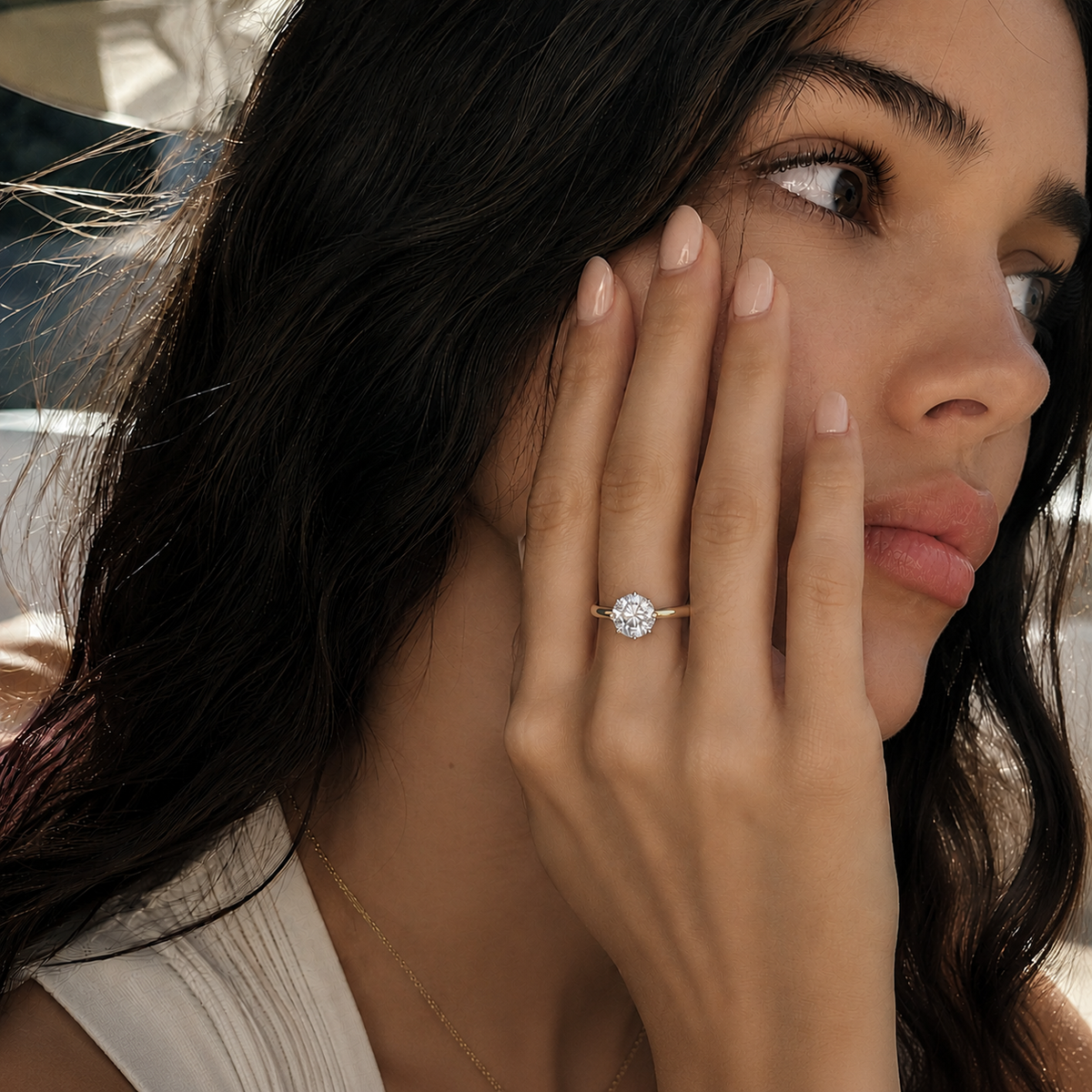
At roughly $1,000, buyers are typically looking at classic solitaire designs and simpler settings.
-
Around $2,000, there's more room to choose between shapes, add halo details, or size up the center stone.
-
At $3,000, the budget opens up further for larger stones, more intricate settings, or higher color and clarity grades.
None of these tiers is inherently "the good one"; the right ring is the one that matches your priorities and your finances, which is really the heart of the engagement ring budget question in the first place.
How Much Should I Spend on an Engagement Ring?
There's no universal rule here, and any rule of thumb that claims otherwise is worth ignoring. The old advice to spend two or three months' salary on a ring didn't originate from financial planning — it came from a decades-old diamond industry marketing campaign, and it has no bearing on your actual budget, debt, or goals.
A more useful way to think about your engagement ring budget is to look at your own numbers:
-
Monthly income and existing savings
-
Any current debt or upcoming major expenses
-
Your combined wedding budget, if one exists yet
-
Whether you want to keep an emergency fund untouched
-
Your partner's taste and expectations around the ring itself
-
What you personally want to prioritize like size, design, or a mix
The most workable principle is simple: spend an amount you can comfortably afford without derailing other financial priorities. That might land at $900. It might land at $4,000. Both are reasonable if they fit your life.
What Does $1,000 Buy in a Lab-Grown Diamond Engagement Ring?
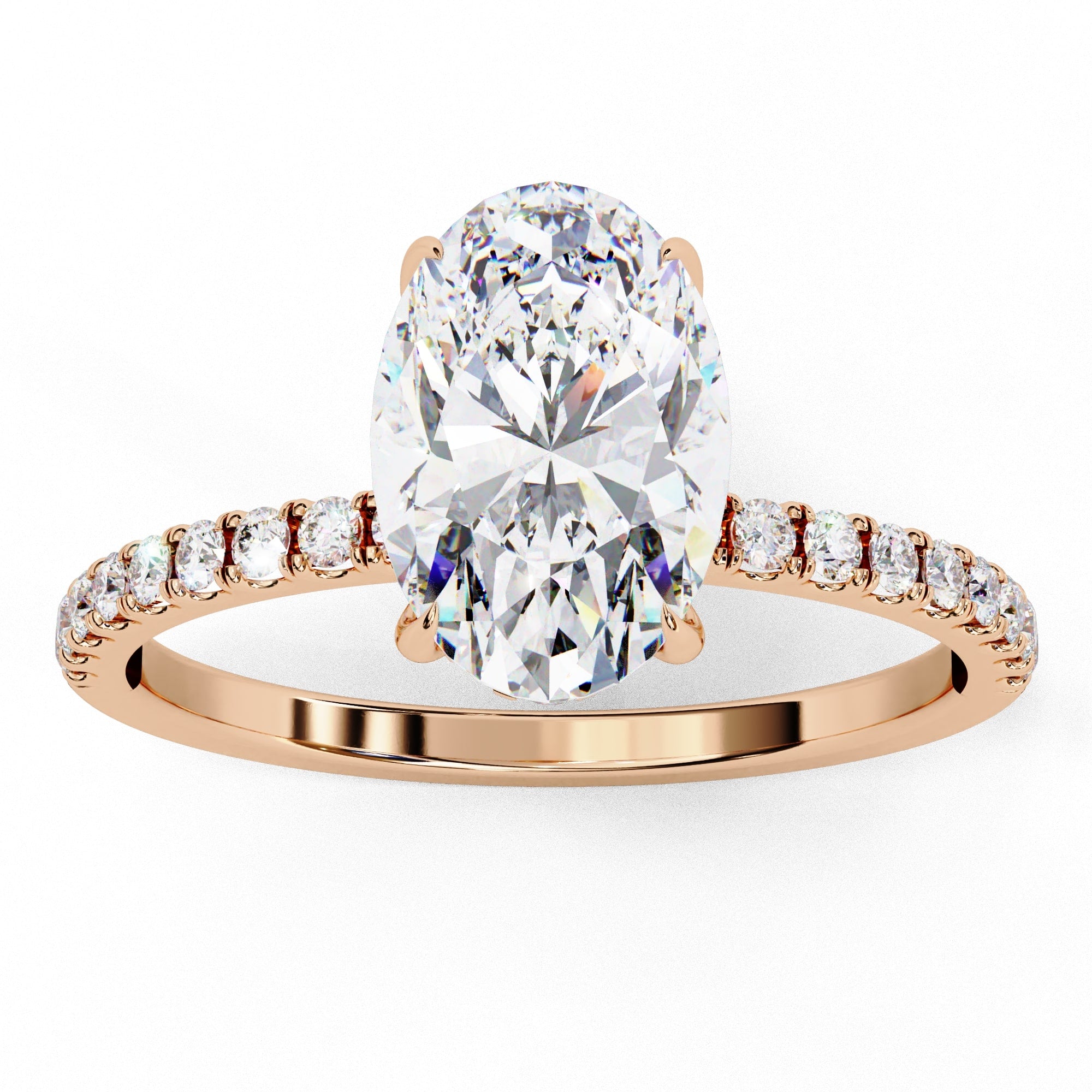
At the $1,000 mark, you're generally looking at genuine lab-grown center diamonds in the 0.7 to 1.2 carat range, set in solid 14K gold, with classic shapes like oval, pear, or marquise leading the way. Solitaire diamond ring settings are common here, though some halo designs also fall into this range depending on stone size and current specifications.
This tier appeals to buyers who want a real diamond ring without stretching their budget, or who'd rather put extra money toward the wedding, a house, or savings. It's not a compromise tier, and it's a starting point that still delivers certified diamonds and durable metal.
For a closer look at what's currently available, Alyce Jewels lab-grown diamond engagement rings under $1,000 collection includes solitaire and hidden halo styles across several shapes, all with independent grading reports.
What Does $2,000 Buy in a Lab-Grown Diamond Engagement Ring?
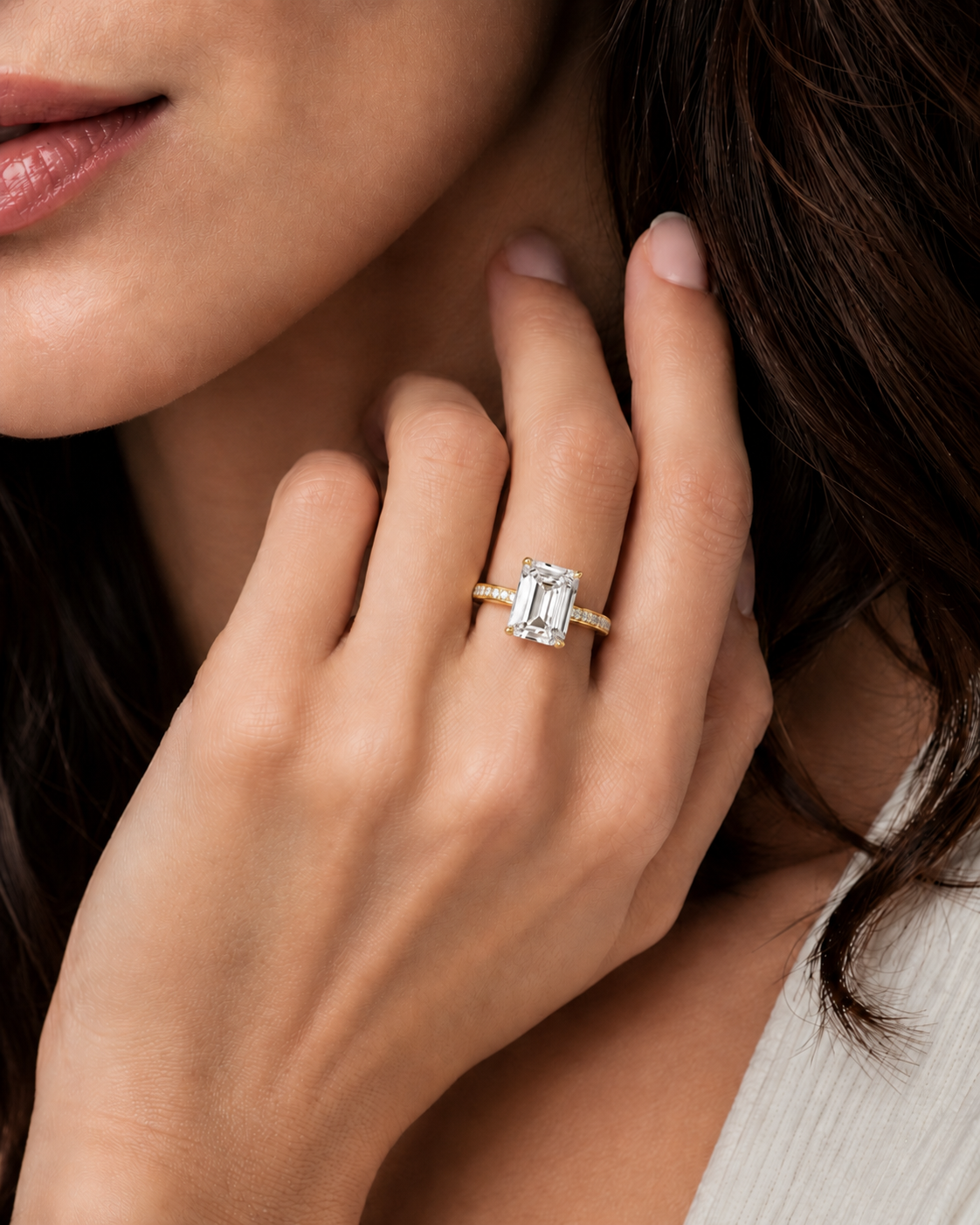
Move into the $2,000 range, and the flexibility expands noticeably. This is where buyers often start weighing trade-offs more deliberately: a bigger center stone versus a more detailed setting, a classic round versus an elongated emerald or radiant cut ring, or a straightforward solitaire versus a halo that adds visual size.
Specifications still vary widely by shape, cut quality, color, clarity, and current inventory, so no two $2,000 rings are identical. What tends to be consistent is more room to prioritize: buyers at this level have enough headroom to get closer to their "wish list" without pushing every dial to its maximum.
Alyce Jewels' lab-grown diamond engagement rings in the $1,000–$2,500 range are built around exactly this kind of decision-making, with a wide mix of shapes, carat weights, and setting styles to compare side by side.
What Does $3,000 Buy in a Lab-Grown Diamond Engagement Ring?

Think of $3,000 less as a guarantee of a bigger diamond and more as a flexible budget. It can go toward a larger center stone, but it can just as easily go toward a more complex setting that exists in different types of rings. This includes a hidden halo, better color or clarity grading, or a less common shape that costs more to cut well.
At $3,000, the more useful question isn't "what's the biggest diamond I can get?" It's "which combination of diamond quality and design matters most to me?" Some buyers use the extra budget for size. Others use it to upgrade cut quality or clarity on a moderately sized stone, which can make a bigger visual difference than carat weight alone. Neither approach is more correct; they just reflect different priorities.
Because exact products and prices shift over time, this tier is best explored directly through Alyce Jewels' lab-grown diamond engagement rings collection, where you can filter by shape, style, and price.
$1,000 vs. $2,000 vs. $3,000 Lab-Grown Diamond Rings
|
Budget |
What You Can Prioritize |
Typical Design Direction |
Best For |
|
$1,000 |
Value, classic design, simpler settings |
Solitaire, minimal halo, classic shapes |
Budget-conscious buyers who still want a certified |
|
$2,000 |
More diamond and design flexibility |
Larger center stones, halo or hidden halo, varied shapes |
Buyers who want more choice between size and setting |
|
$3,000 |
Greater flexibility across diamond and setting |
Larger or more elaborate designs |
Buyers prioritizing customization or premium detail |
These are budget tiers, not fixed product specifications: actual carat weight, shape, and setting will vary by individual ring and current availability.
Where Should You Spend More: Carat, Cut, Clarity or Setting?
This is where a lot of buyers get stuck, because it's tempting to fixate on carat weight as the main measure of value. It isn't.
-
Cut determines how well a diamond reflects light. It’s the single biggest factor in how much a stone actually sparkles, regardless of size.
-
Carat measures weight, not beauty. Two stones of the same 2-carat weight ring can look very different depending on cut and shape.
-
Color grading matters more or less depending on the shape and setting, where a warmer metal tone can make a slightly lower color grade far less noticeable.
-
Clarity is often overrated by first-time buyers, since many inclusions in the mid-range grades (VVS-VS) aren't visible without magnification. Look at this 1.24 carat oval and round VVS clarity halo diamond ring as it looks proper.
-
Ring Setting affects both how the stone reads visually and how securely it's held day to day.
A reasonable general framework, though not a rigid rule for every buyer, is to weigh cut and visual appearance first, then overall design. After that, certification, then the balance of color and clarity, with carat size factored in last.
Does Lab-Grown Mean You Get More Diamond for Your Money?
Lab-grown diamonds are real diamonds and are graded using the same 4Cs framework. What differs is origin and, as a result, price: lab-grown stones typically cost a fraction of mined diamonds of comparable size and quality.
That price difference doesn't make lab-grown diamonds "cheap," but it changes how far a fixed engagement ring budget can go. A buyer working with $2,000 has more room to consider carat size, shape, or setting complexity than the same budget would allow with a mined stone. It's a matter of flexibility, not a shortcut around quality.
Which Diamond Shape Gives You the Most Value?
Popular shapes each bring something different to the table: round for classic brilliance, oval and princess side stone rings for a unique look, radiant and cushion for sharp geometric lines, emerald for a clean, modern silhouette, and marquise for softer or more dramatic outlines.
Elongated shapes, including oval, pear, marquise, and radiant among them, create more visible finger coverage relative to their carat weight than round stones do, though actual appearance depends heavily on the specific proportions of the cut.
Why Radiant-Cut Lab-Grown Diamonds Are Worth Considering?
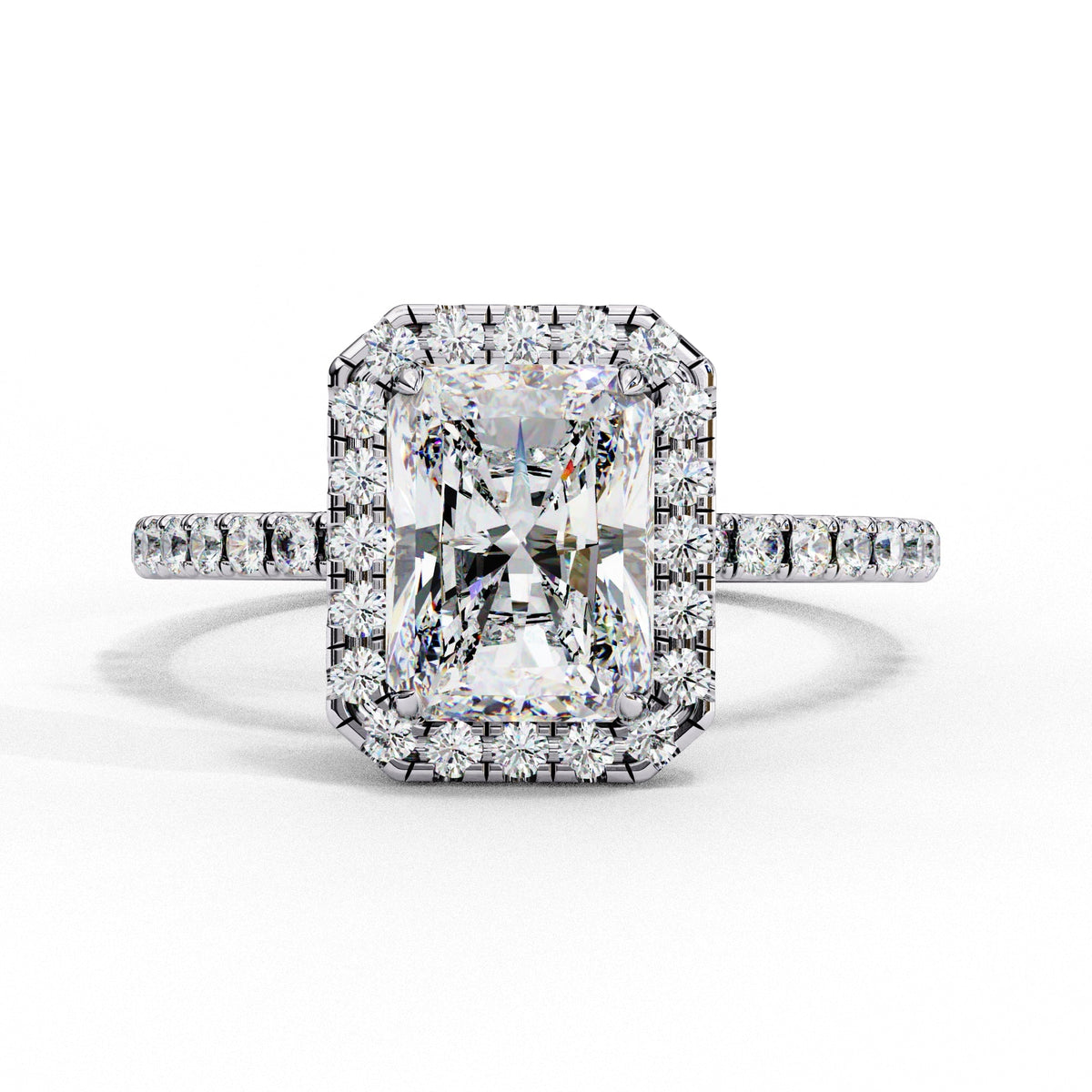
Radiant cut pairs a rectangular or square outline with brilliant faceting, which gives it strong sparkle alongside cleaner, more geometric lines than a round or oval stone. Trimmed corners also make it a fairly durable everyday shape.
Between emerald and radiant cut engagement rings, the difference is not sparkle but a unique look. Emerald diamond known for their clear look and transparency. A radiant provides a flat surface and reflection that makes preferable choice.
Radiant diamond’s versatile enough to work in solitaire, halo, or hidden-halo settings, which is part of why it shows up across a range of budgets rather than being locked into one price tier.
Alyce Jewels' radiant-cut lab-grown diamond engagement rings collection includes solitaire and halo styles worth comparing if the shape appeals to you. Select the best settings in 14K or 18K gold in three metal tones, including yellow, rose, and white.
When Deciding Your Engagement Ring Budget, Don’t Make These Mistakes
-
Following the "three months' salary" rule.
It’s your choice how much you’re ready to spend on the engagement ring, despite deciding it solely based on your salary. If a $ 1,000 ring range is convenient, then it’s good, and spending $ 3,000 is never tough; go for it.
-
Buying the largest carat possible.
A bigger stone with poor cut quality can look flatter and less lively than a smaller, well-cut one. Focus on a Very Good to Good cut grade, even in Round brilliant or Oval shape within 1 carat.
-
Ignoring the setting.
The setting shapes how the ring looks day to day and how well it holds up over years of wear. A solitaire ring takes less budget as it only gets a single stone compared to halo or three-stone ring settings.
-
Focusing only on the discount.
A steep percentage off an inflated price isn't the same as genuine value. Compare final price and specifications instead. For example, the Labor Day Engagement Ring sale is live; then check what it is useful for and then make a purchase.
-
Spending beyond your comfort zone.
An engagement ring shouldn't come at the cost of financial stress heading into a marriage. If you have enough budget to spend easily around $1,500 on the ring the most beautiful setting and high-quality design available in lab-grown diamonds.
Shop Lab-Grown Diamond Engagement Rings at Alyce Jewels
Wherever your budget lands, Alyce Jewels organizes its lab-grown diamond engagement rings by price and style, which makes comparing tiers more straightforward than shopping loose search results. Buyers working with a tighter budget can start with the under $1,000, while those with more room to work with can browse the $1,000–$2,500 collection or the radiant-cut collection for a specific shape. The entire lab-grown diamond engagement ring collection covers every shape and style beyond these price bands.
Conclusion
There's no single "right" amount to spend on a lab-grown diamond engagement ring. $1,000 can be a genuinely solid starting point. $2,000 opens up more choice between size, shape, and setting. $3,000 adds further room for larger stones or more detailed craftsmanship. None of these tiers is automatically the better ring — cut quality, certification, and setting matter just as much as the number on the price tag.
The right budget is the one that gets you a ring you'll actually love wearing every day, without pulling from money you need elsewhere. From there, it's worth browsing Alyce Jewels' lab-grown diamond engagement ring collections by price and style to see what fits.
FAQs
-
How much should I spend on an engagement ring?
There's no universal spending rule. The right amount depends on your income, savings, existing debt, wedding plans, and personal priorities — not a fixed formula.
-
How much does a good lab-grown diamond engagement ring cost?
Quality isn't tied to one price point. A well-made lab-grown diamond ring can be found around $1,000, $2,000, or $3,000, with the difference coming down to diamond specifications and setting complexity rather than one budget being objectively "better."
-
Is $1,000 enough for a lab-grown diamond engagement ring?
Yes — at this level, buyers can typically expect a genuine certified lab-grown diamond in a classic solitaire or simple halo setting, in solid gold, without stretching finances.
-
Is $2,000 enough for a good engagement ring?
It often provides more flexibility to choose between a larger center stone, a wider range of shapes, or a more detailed setting than the $1,000 tier allows.
-
Is $3,000 too much to spend on a lab-grown diamond ring?
Not if it fits your financial situation and gets you the combination of diamond quality and design you actually want. It's not too much or too little on its own.
-
Are lab-grown diamonds worth it for an engagement ring?
For many buyers, yes — they're chemically identical to mined diamonds and typically cost less for comparable size and quality, which can free up budget for other priorities. Whether they're "worth it" ultimately comes down to personal preference around origin.
-
What should I prioritize when buying a lab-grown diamond?
Cut quality and overall visual appearance generally matter most, followed by certification, the balance of color and clarity, and finally carat size.
-
Which diamond shape looks biggest for its carat weight?
Elongated shapes like oval, pear, and marquise tend to show more surface area than round stones of the same weight, though final appearance depends on the specific cut proportions.